Canal & mutual ditch company software

Canal company software built on shares, not allotments.

A mutual company is organised around two things a generic water tool gets wrong: water is held in shares, and it is delivered down a branching network of laterals and turnouts. Loamio models both directly — share count times acre-feet per share for the right, and the real canal network for the delivery — so the software agrees with your bylaws in August.

Shares

One number the whole season turns on.

Every shareholder's right is stored as share count times acre-feet per share. That is not a formatting preference — it is what makes a dry year tractable. When the board sets acre-feet per share, every right in the company recalculates from that single figure instead of from four hundred hand edits, and a pro-rata cut becomes pro rata by construction rather than by careful arithmetic. Assessments bill off the same share count, so the bill and the water right cannot quietly drift apart.

How drought curtailment works →

The network

Laterals and turnouts, not a flat list of connections.

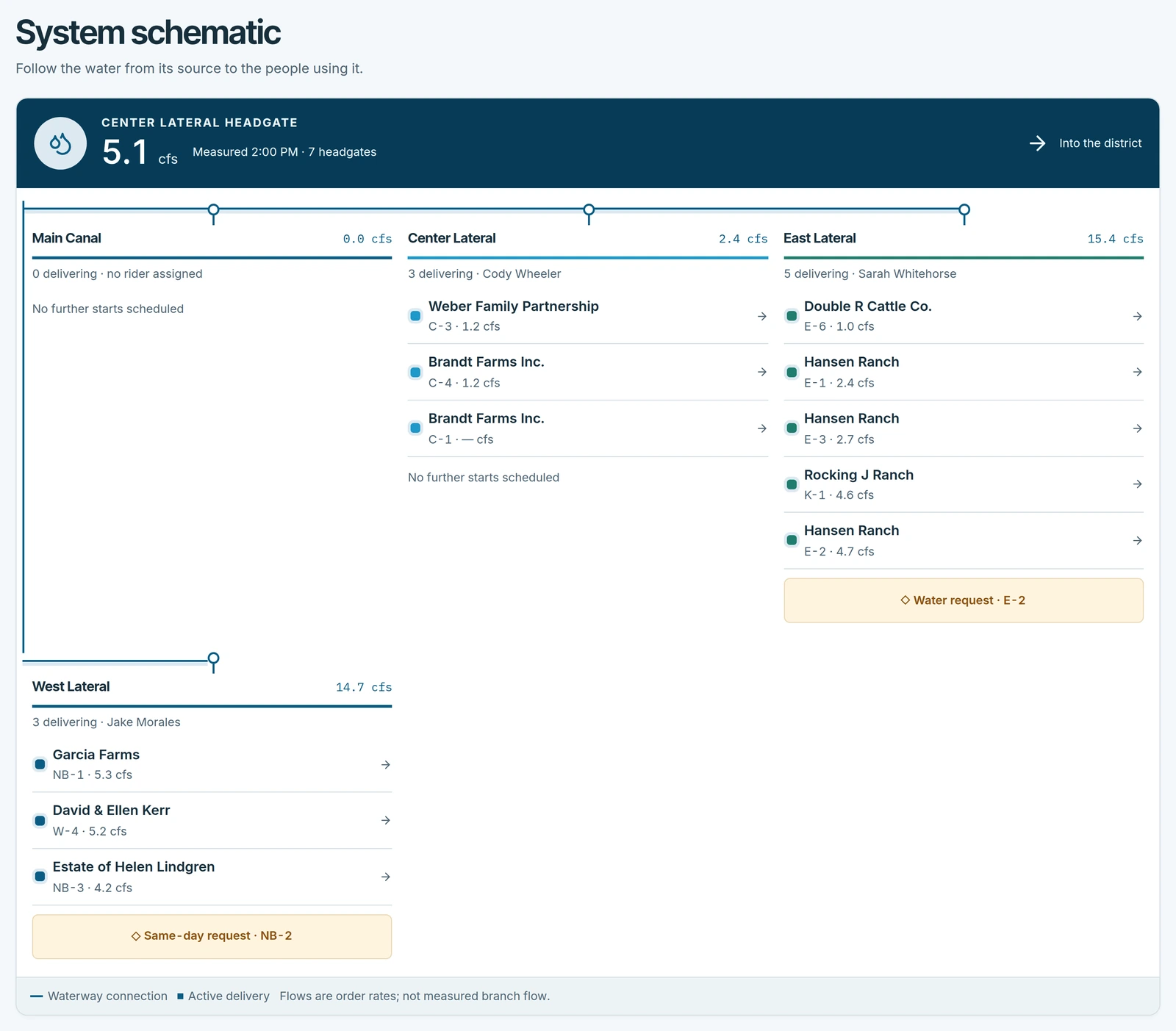
A canal company does not deliver to independent points; it delivers down a system where everyone on a lateral is affected by what happens upstream of them. Loamio keeps the structure: headgates, turnouts, and laterals drawn on the district map, and a hydraulic schematic built automatically from that same network — main ditch at the root, laterals branching off it, turnouts hanging off the laterals. Each turnout lights up when water is running through it, so a shutoff makes its downstream consequences visible before it happens rather than after the phone rings.

The Loamio schematic screen showing the ditch network as a lateral-rooted tree, with active turnouts highlighted.
The schematic — laterals branch from the main ditch, and active turnouts light up where water is running.

How the map works → · How the schematic works →

The office

Assessment season, in one run.

Mutual companies live and die by the annual assessment, and it is usually the single most error-prone week of the year because share counts sit in one place and payments in another. Loamio bills every shareholder from the same ledger the water rights come from and collects through Stripe by ACH, card, or invoice, with paid, pending, and failed tracked in one place. Processing fees pass through at cost, and there is no setup fee and no per-shareholder charge.

More on the office side →

Sized for a mutual

Priced for a company run by its own members.

Most mutual ditch companies are run part-time by people who also farm, and they have historically had two options: a custom system at $150K–$350K, or a spreadsheet. The Lateral plan at $99/mo is aimed squarely at small mutual companies and includes water orders, the offline ditch rider app, assessment billing, and the share-based ledger — not a stripped tier designed to push you upward. There is a 14-day free trial and no credit card is needed to start.

See full pricing →

Questions

Canal company software, answered.

What makes canal company software different from generic water software?

A mutual canal or ditch company allocates by shares, not a flat per-acre allotment, and delivers through a branching network of laterals and turnouts rather than independent connections. Software that models a patron as one allotment number, or the system as a flat list of delivery points, disagrees with the bylaws and with the ditch by mid-season. Loamio models both directly.

How does Loamio handle shares and acre-feet per share?

Each shareholder's right is share count times acre-feet per share. When the board sets acre-feet per share, every right recalculates from that one number rather than hundreds of edits, and season-to-date usage is measured against the result. Assessments bill off the same share count, so the bill and the right cannot drift apart.

Can Loamio model our laterals and turnouts?

Yes. Headgates, turnouts, and laterals are drawn on the district map, and Loamio builds a hydraulic schematic automatically from that network — main ditch at the root, laterals branching off, turnouts on the laterals. There is no separate diagram to maintain; add a turnout to a lateral and it appears in the right place.

How does a pro-rata cut work in a dry year?

Because rights are computed from acre-feet per share, cutting that figure applies the reduction pro rata across every shareholder by definition. Loamio publishes the cap as a dated decision and sorts every patron ok, near-limit, or over against it, with a CSV report for the board.

Do we pay per shareholder?

No. Pricing is flat — $99/mo Lateral, $299/mo District — with no per-shareholder and no per-user charges and no setup fee. Stripe processing fees on patron payments pass through at cost.

Related: Irrigation district software · Water district software · Ditch rider software · Water order management · The whole system, simple to run

Next step

See it with your own share structure.

A 20-minute walk-through using your shares, your laterals, and your assessment cycle. We respond within one business day.

Book a demo