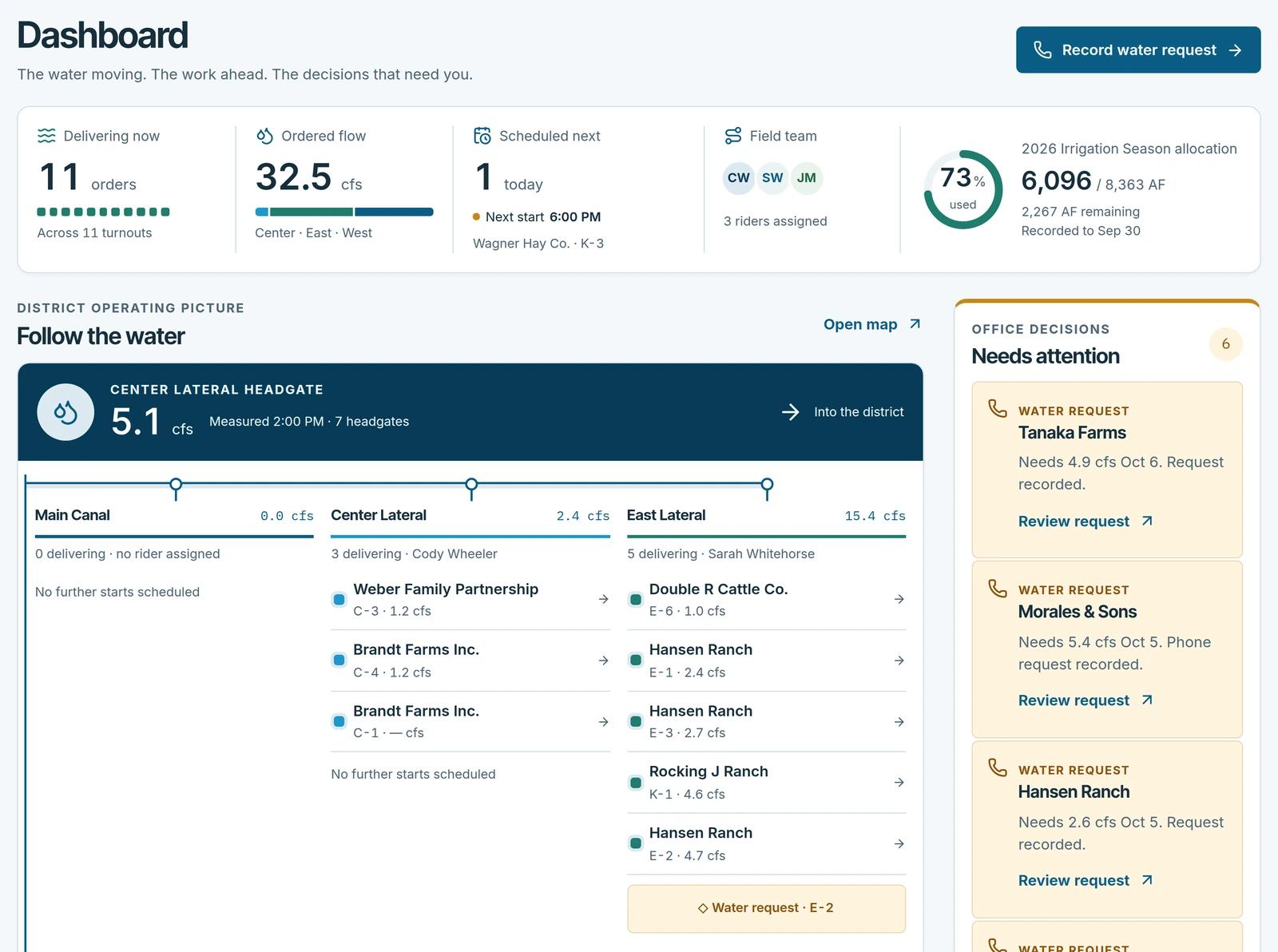
Take and approve water orders
Orders arrive by phone, text, paper, or the app, and the office approves before anything moves. They land on a calendar organised by headgate so the week is visible at a glance.
Loamio is irrigation district software for small irrigation districts and mutual ditch companies — water orders, ditch rider run sheets, a share-based water rights ledger, and assessment billing in one system. Flat $99–$299 a month, no per-user or per-shareholder fees, and a 14-day free trial with no credit card.
The category
Irrigation district software earns its keep by covering the whole week, not one slice of it. Most districts do these five things every season; most tools handle two or three and hand the rest back to a spreadsheet.
Orders arrive by phone, text, paper, or the app, and the office approves before anything moves. They land on a calendar organised by headgate so the week is visible at a glance.
Riders get a run sheet on the phone, mark deliveries at the structure, and note what actually happened — including the skips and the partial deliveries.
Shares times acre-feet per share, not a flat allotment, so each patron's right and season-to-date usage stay exact and defensible.
Bill every shareholder by share count and collect by ACH, card, or invoice through Stripe, with paid, pending, and failed tracked in one place.
An audit log, a CSV export of everything, and a per-patron order history to point at when someone disputes what they got in July.
Sized for small districts
The reason so many districts still run on a spreadsheet is not that they like the spreadsheet. A custom-built district system runs $150K–$350K, and the established vendors quote rather than publish. Loamio publishes its price and charges the same whether you have forty shareholders or four hundred.
The field half
Irrigation district software that needs a connection is office software with a phone screen. There is no signal at most headgates, so Loamio's field app is offline-first: the rider records deliveries, skips, and notes at the structure, and everything syncs by itself once the device is back in range. Map tiles cache the same way — load the district map on Wi-Fi in the morning and it keeps working out on the ditch.
The office half
Western water is held as shares, and a system that models it as a single number per patron will disagree with your bylaws by August. Loamio tracks water rights the way the district issued them — share count times acre-feet per share — so the ledger, the season-to-date usage, and the assessment all compute from the same figure. Assessment season becomes a billing run instead of two weeks of manual reconciliation.
The dry-year half
Set a cap, publish it as a dated decision, and see every patron sorted ok, near-limit, or over — with a CSV for the board.
Acre-feet per water-righted acre by irrigation method, anonymized so a method only appears once at least three patrons use it.
The network drawn as a tree, each turnout lighting up when water is running through it — so you can see who is downstream of a shutoff.
Questions
It is the system a district or mutual ditch company uses to run water delivery and the office work around it — taking and approving water orders, dispatching ditch riders and recording what was actually delivered, tracking each patron's water right, and billing annual assessments. Districts without it usually split those jobs across a spreadsheet, paper run sheets on a clipboard, and shareholder records in a filing cabinet.
Loamio is $99/mo (Lateral) or $299/mo (District), flat, with no per-user and no per-shareholder charges and no setup fee — and the price is published rather than quoted. A custom-built district system typically runs $150K–$350K, which is the reason most small districts stayed on spreadsheets.
Yes — that is what it is built for. The Lateral plan is aimed at small mutual ditch companies and includes water order management, the offline ditch rider app, assessment billing, and the share-based ledger rather than holding them back for a higher tier. Because pricing is flat, adding shareholders or riders does not change the bill.
Yes. The field app is offline-first — a rider records deliveries, skips, and notes at the headgate with no signal, and the changes sync automatically once the device is back in range. Map tiles cache the same way, so the district map keeps working out on the ditch after it has loaded on Wi-Fi.
Yes. Shareholders, the ledger, orders, and billing history export to CSV at any time. The records your district puts into Loamio belong to your district, and they are never sold, licensed, or shared with another party.
Related: Water district software · Ditch rider software · Water order management · Canal company software · Loamio vs. Watervize
Next step
A 20-minute walk-through using your headgates and your share structure. We respond within one business day.
Book a demo