
Loamio / Ditch rider software
The day's route, out at the gate.
Assigned deliveries and field actions in a phone-sized workspace.
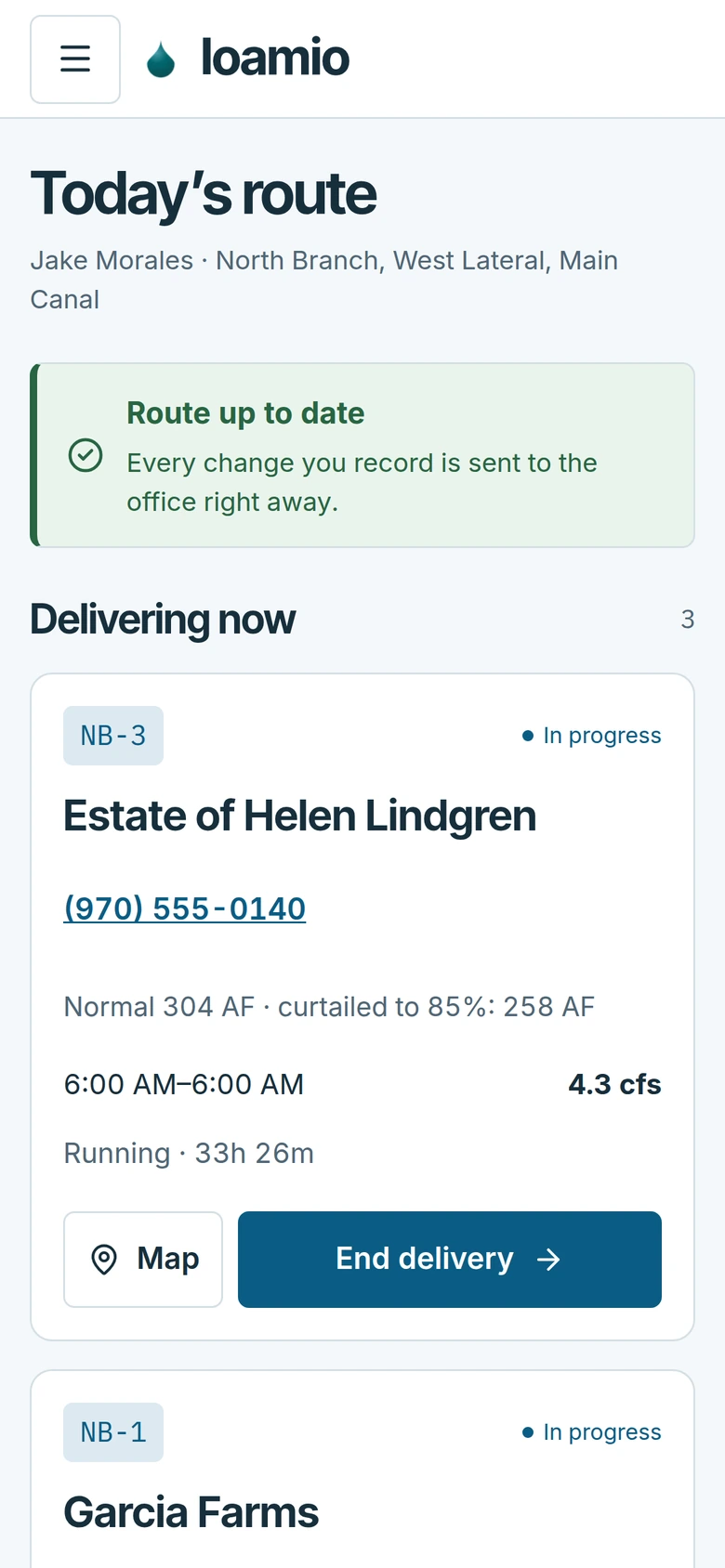
Open the assigned route.
See the delivery details for the day's work.
Record at the delivery.
Use the start and end actions on the delivery card.
Check the sync state.
Read the app's connection and sync messages before leaving the route. Open your route before heading out. Record delivery activity when signal drops, then sync when you're connected again.
Ditch rider software
The working details.
What is ditch rider software?
It puts the ditch rider's route on a phone instead of a paper run sheet. The ditch rider taps Start delivery and End delivery at each turnout and confirms the cfs reading, and the office sees the record without a phone call. Open your route before heading out. Record delivery activity when signal drops, then sync when you're connected again.
Does the ditch rider app work offline?
Open your route before heading out. Record delivery activity when signal drops, then sync when you're connected again. Starts and ends recorded without signal sync automatically when the connection returns.
Do ditch riders cost extra per user?
No. Pricing is flat: $99.00/month for Lateral and $299.00/month for District, with no per-user or per-patron charges. Adding a ditch rider does not change the bill, and the ditch rider app is included in Lateral.
Can a ditch rider use the district map in the field?
Yes, with a connection. Headgates, turnouts and laterals are drawn on the district map, which is in the ditch rider's menu. The route's Map button needs a connection.
What stops a ditch rider from changing something they should not?
Access is role-based. A ditch rider can start and end only deliveries assigned to them. Billing, shares and other office screens are not available to a ditch rider account.
See Loamio at work
See it with your district in mind.
Bring a water order, a run sheet, or an assessment question to a 20-minute walk-through.